Belonging
What a Nation Looks Like When It Decides Some People Don’t Belong

The United States Congress is made up of 535 elected human beings.
1/10,000th of one percent of the population. And yet, we, due to their station, amplify their voices extraordinarily. Why? In part, because they represent us. We’ve chosen them.
And too often, we choose…poorly.
This morning, a sitting member of that United States Congress posted eleven words on Musk’s Twitter/X platform, ones that deserve more than outrage.
They deserve a reckoning.
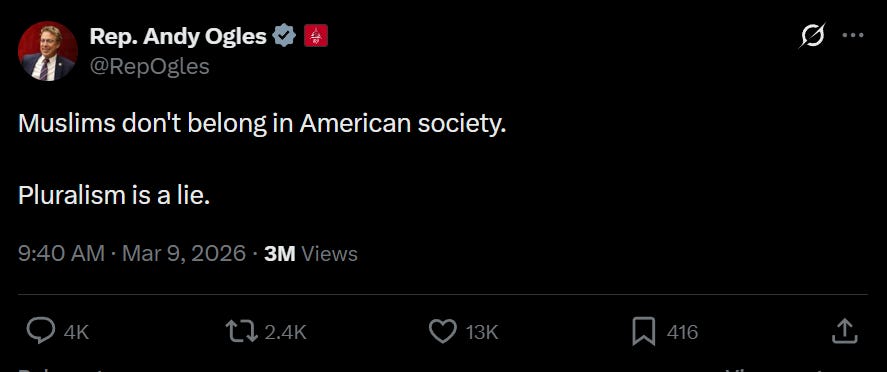
“Muslims don’t belong in American society,” wrote Rep. Andy Ogles (R-Tenn.) on social media. “Pluralism is a lie.”
Eleven words. Two sentences. And in them, a complete philosophy of exclusion. One with a very long, very documented, very catastrophic history.
Let’s talk about that history. And let’s talk about what’s being dismantled when someone with a congressional pin and a platform says something as failed and crippled as this, and faces no consequence.
April 5, 1968
The day after Martin Luther King Jr. was assassinated, a third-grade teacher in Riceville, Iowa named Jane Elliott walked into her classroom and did something that would haunt - and educate - the world for the next half-century.
She decided to base an exercise on eye color rather than skin color, to show the children what racial segregation would be like. Blue-eyed children were told they were inferior. Restrictions were placed on them. Brown-eyed children were handed privilege and told to use it.
Elliott found that the children quickly adopted the prejudiced behaviors associated with their designated status. Those labeled as superior exhibited increased confidence, performed better academically, and engaged in discriminatory behavior toward their peers. Conversely, those labeled as inferior displayed lower self-esteem, poorer academic performance, and heightened anxiety and distress.
These were eight-year-olds. It took less than a day.

A smart blue-eyed girl who had never had problems with multiplication tables started making mistakes. She slumped. At recess, three brown-eyed girls ganged up on her.
The lesson Elliott was trying to teach was not subtle: the machinery of exclusion doesn’t require ancient hatred or centuries of doctrine. It requires only an Ogles, only an authority figure telling children - or citizens, or voters - that some among them are lesser. That some don’t belong.
The children didn’t need to hate each other before Elliott’s exercise. They needed only to be told a story about who mattered and who didn’t.
The experiment demonstrated that even arbitrary distinctions could create deep-seated prejudice and discrimination, leading to significant psychological and emotional consequences. It underscored the idea that discrimination is learned behavior and that societal structures and authority figures play a crucial role in perpetuating biases.
Congressman Ogles is not a third-grade teacher in a controlled classroom setting. He is a federal legislator with a verified account, 3 million views, and the implicit imprimatur of a political party that has chosen not to censure him.
He is telling a story about who belongs. And people are paying attention.
Many are listening.
There is a specific cruelty in Ogles’s second sentence that often goes unexamined. “Pluralism is a lie” is not merely an expression of preference. It is a claim about reality, a denial that diverse people can live together with their dignity intact, that a multiracial, multifaith democracy is even possible, let alone worth protecting.
That a capacity for national truth and justice might be the extent that we persist among each other, different yet one.
It is worth understanding what Ogles is arguing against before we argue back.
Pluralism emphasizes everyone’s ability to thrive, with all their differences fully respected. Cambridge Dictionary defines pluralism as “the belief that the existence of different types of people within the same society is a good thing.” Pluralistic practices and mindsets are ways for us to collaborate, live, and pray peacefully with and alongside one another. In a healthy pluralistic democracy, what we share in common and where we greatly differ are viewed as a source of strength and a springboard for innovation.
When Ogles says pluralism is a lie, he is saying that this is impossible. That it is naive. That the dream of a country where people of different faiths, origins, and backgrounds share civic life as equals is a fantasy.
He is wrong. And not just morally; Ogles is wrong empirically, historically, and practically. He functions, pathetically, as wrong across as many dimensions as we have, for life, liberty and the pursuit of happiness.
The promise of pluralism is embedded in America’s founding ideals of liberty, equality, and justice. This is not sentimentality. It is the constitutional architecture of the republic. The First Amendment does not protect Christian speech. It protects speech. It does not guarantee religious freedom for Protestants. It guarantees religious freedom. The founders (imperfect, hypocritical, slaving and enslaved to their own contradictions as many of them were) still understood that a nation built on exclusion would consume itself. E Pluribus Unum - out of many, one - has been on the national seal since 1782.
As Representative Shri Thanedar put it: “The founders put freedom of religion in the FIRST Amendment for a reason. Muslims have lived in America since the 1600s. E Pluribus Unum, an ode to our pluralism, has been our country’s traditional motto since 1782. Maybe it’s YOUR values that don’t belong in American society.”
This is the part that should frighten everyone who is not themselves a Muslim, which is to say, it should frighten everyone.
The logic embedded in “Muslims don’t belong” does not contain within itself any principled stopping point. It is a logic of categorical exclusion based on identity, and history has demonstrated with terrible, horrible consistency that such logics only expand.
Jane Elliott’s classroom showed us that children absorb the lesson of who matters and who doesn’t with stunning speed. They then apply it. The “inferior” group internalizes shame; the “superior” group internalizes license. Both outcomes are dangerous. Both outcomes scale.
The question the Ogles post invites (and that we must have the courage to ask plainly) is: who decides which identity is disqualifying, and when does the list stop growing?
Ogles isn’t the only Republican in Congress comfortable with being openly, hatefully Islamophobic. Last month, Rep. Randy Fine (Fla.) declared on social media: “If they force us to choose, the choice between dogs and Muslims is not a difficult one.” Rep. Lauren Boebert (Colo.) has made numerous baseless, bigoted remarks about Rep. Ilhan Omar (D-Minn.) In 2025, Sen. Tommy Tuberville (Ala.) called for banning all immigrants who are Muslim.
Far-right influencer Laura Loomer, who at times has had the ear of President Donald Trump, responded: “Amen. More GOP reps need to start saying this.”
There is some type of a constituency for this. There is a type of momentum behind it. And that momentum has never in history been content with a single target.
Ogles has also a long history of bigoted comments. He said America “should kill ‘em all” last year regarding Palestinians in Gaza. He called for sending pro-Palestine student protesters to Gaza. This is not a man who will draw a line. There is no line in his framework. There is only the next group.
The nightmare vision of an America governed by Ogles’s values is not speculative. It is historically documented. Societies that formally exclude based on religion move, with time and political permissiveness, toward ethnic exclusion, then toward violence against the excluded. The mechanism is always the same: dehumanization first, policy second, violence third. The difference between what we perceive a group thinks and what that other group actually thinks creates misperceptions that make it harder for people to engage across differences, leading to distrust, disconnection, and toxic polarization. Ogles is not just expressing prejudice. He is manufacturing the misperception, at scale, that Muslims are not neighbors, colleagues, veterans, teachers, parents…but threats. Invaders. Non-persons.
And what people who offer up discourse like Ogles have historically done to beings they consider non-persons? It’s too horrible to recount here.
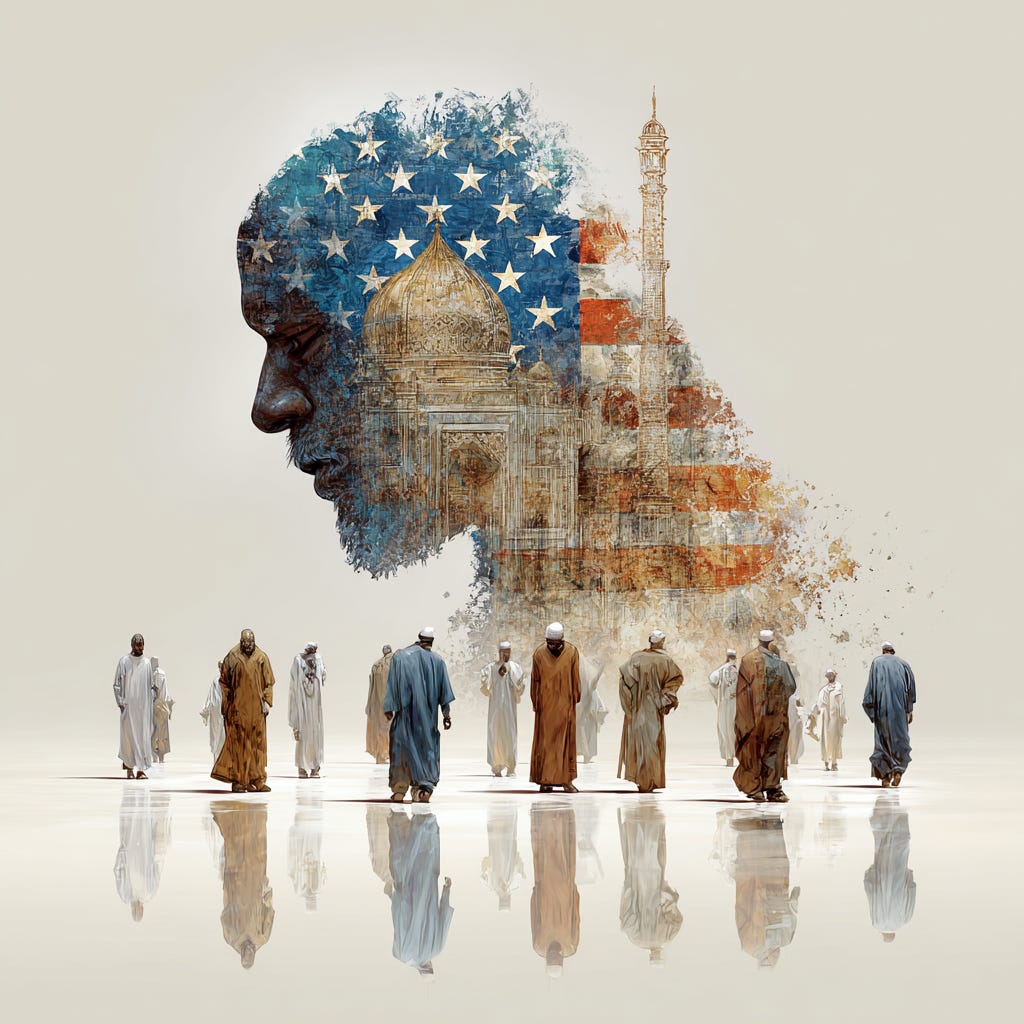
Against this, something quiet and determined is being built.
The Einhorn Collaborative, a foundation dedicated to social connection and civic cohesion, has spent years working on what it calls the four pillars of a connected society: Bonding, Bridging, Building, and Belonging (I worked with the Collaborative on A Call to Connection, a primer on “Rediscovering the Transformative Power of Relationships”). Their commitment to fostering true belonging means they are unwilling to collaborate with people or organizations grounded in the dehumanization or rejection of entire groups, simply because of what they look like, whom they love, how they pray, or where they are from. They believe that respectful dialogue across differences is both possible and necessary, but it must be grounded in mutual recognition of each person’s inherent dignity.
This is not a feel-good platitude. It is a practice. It is the architecture of a democracy that actually functions.

From this foundation grew the New Pluralists - a project of several large and cross-partisan philanthropic organizations including the Einhorn Collaborative, the Stand Together Trust, the Fetzer Institute, and the William and Flora Hewlett Foundation, with the goal of reducing social tension and division. Notably, this could not be described as an ostensibly left-wing project. It includes Koch-aligned funders alongside progressive foundations, because pluralism, properly understood, sits suitably outside partisan constructions, and functions itself as a structural one. It is what makes democracy survivable.
New Pluralists’ 2030 Strategy moves the collaborative from broad, experimental grantmaking to more targeted investments addressing three barriers to pluralism: dehumanization, disconnection and distrust.
Dehumanization. That word appears as deliberately in the New Pluralists’ intention as the act does in Ogles’ posts. The researchers and practitioners working in pluralism are not naive about what they’re fighting. They describe their work as curbing the crisis of connection, in which more and more Americans are living in isolation, loneliness, anxiety, and fear, eroding faith in our institutions and each other.
Loneliness and fear are the soil in which Ogles-style politics grows. Not strength. Not pride. Not courage.
Fear.
The man broadcasting from a congressional seat that your Muslim neighbor is an invader is speaking to, and amplifying, a particular kind of American terror. The terror of the person who feels unseen, who fears displacement, who has been told, by Ogles-esque discourses, that their anxiety now has a face and a religion.
The work of organizations like New Pluralists, Resetting the Table, The People’s Supper, StoryCorps, and dozens of their grantee partners is the work of showing people a different story, one in which the neighbor with the different name or prayer is not the source of the fear, but a fellow human being navigating the same bewildering country.
A fellow human being navigating…life.
These people can appear to be in different “lines of business”: political bridge-building, interfaith engagement, racial healing, immigrant inclusion, intergenerational connection, peacebuilding, and collaborative problem solving to name a few.
Yet they are actually part of a larger shared project, exploring similar questions that grow more urgent by the day.
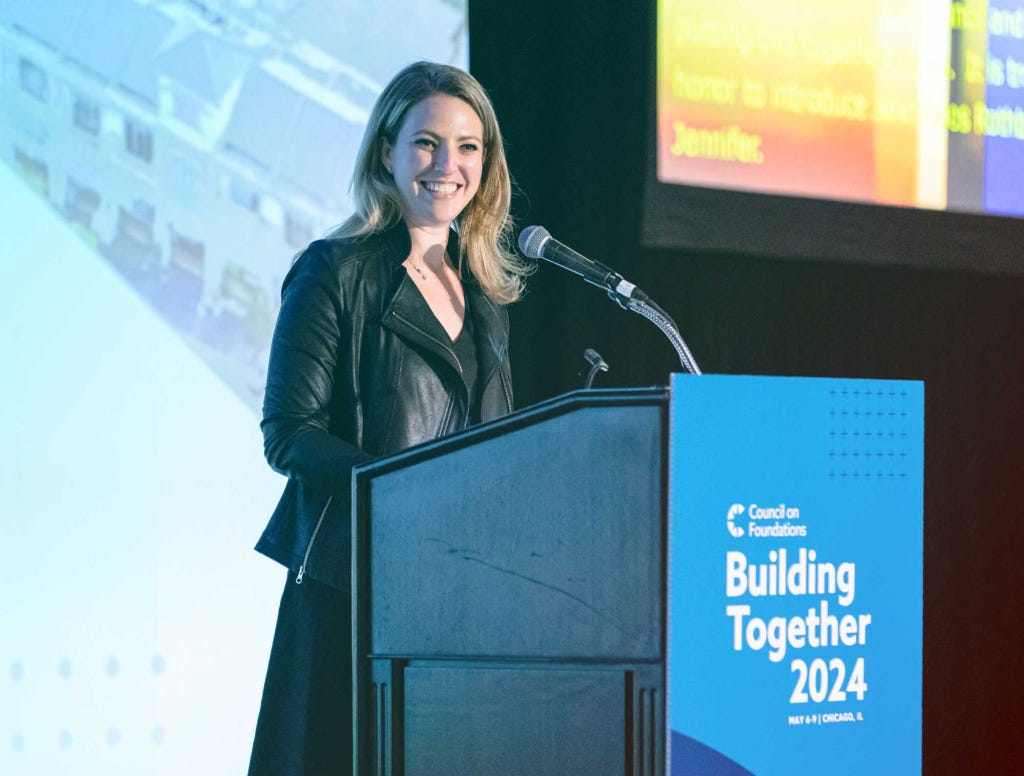
Jenn Hoos Rothberg, who leads Einhorn Collaborative, at the Council on Foundations’ Building Together conference, May 2024.
Here is what Representative Ogles’s America looks like, taken to its logical conclusion: it is a nation in which “belonging” is a revocable license, issued and withdrawn by whomever holds power. Today the license is revoked for Muslims. Tomorrow, it will be revoked for whoever the next scapegoat is.
The children in Jane Elliott’s classroom didn’t pause to consider whether the principle being applied to blue-eyed children might eventually reach them. They were too busy enjoying their privilege…until Elliott flipped the script and made them feel what it was like to be on the other side.
The experiment worked because the children understood, finally and in their bodies, that the perverted and sick logic of exclusion had no natural stopping point. The blue-eyed kids were much less nasty than the brown-eyed kids had been, perhaps because the blue-eyed kids had felt the sting of being ostracized and didn’t want to inflict it as much on their former tormentors.
Empathy, it turns out, is not sentiment. It is information. It is the data you receive when you understand that the person across from you has an interior life as rich and frightened and hopeful as your own.
…We are tied together in life and in the world. And you may think you got all you got by yourself. But you know, before you got out here to church this morning, you were dependent on more than half of the world. You get up in the morning and go to the bathroom, and you reach over for a bar of soap, and that’s handed to you by a Frenchman. You reach over for a sponge, and that’s given to you by a Turk. You reach over for a towel, and that comes to your hand from the hands of a Pacific Islander. And then you go on to the kitchen to get your breakfast. You reach on over to get a little coffee, and that’s poured in your cup by a South American. Or maybe you decide that you want a little tea this morning, only to discover that that’s poured in your cup by [someone] Chinese. Or maybe you want a little cocoa, that’s poured in your cup by a West African. Then you want a little bread and you reach over to get it, and that’s given to you by the hands of an English-speaking farmer, not to mention the baker. Before you get through eating breakfast in the morning, you’re dependent on more than half the world…
- Martin Luther King Jr., The Three Dimensions of a Complete Life, New Covenant Baptist Church in Chicago on April 9, 1967
Our lives are bound up together. Our ability to come together and repair the ruptures in our society requires us to go together and share the road with people who do not live, work, and pray the same way we do.
This is not idealism. This is the operating system of a republic that can last. Remove it, and what you have is not a republic. What you have is a rotating tyranny, each group secure only until it isn’t, each community protected only until the next election (or insurrection), each faith tolerated only until someone with a podcast and a congressional pin decides otherwise.
As Rep. Emanuel Cleaver put it: “Muslims serve in our military, teach our kids, run businesses, and strengthen our communities. They belong in America.”
They do. And so do you. And so does everyone whose belonging has ever been declared a lie by someone powerful enough to say it to 3 million people.
The work of pluralism is never finished. It requires radically new ways of being and acting together. It empowers all of us to examine, to change the way we see and act with one another as people and as groups. This is human, cultural, and generational work.
But the work of exclusion is never finished either. And right now, it has among its hateful, harmful adherents a congressional seat in Tennessee and 3 million views.
The answer to that is not ever silence.
The answer is to keep building the country where everyone belongs, and to do so loudly, persistently, and with the knowledge that pluralism is not a lie. It is among the only honest answers to the question of what America is for.
Share this, please. Talk about it. The antidote to eleven words of exclusion is a thousand words of truth…and then a thousand more.