Empathy
They Called It a Weakness. The Research Calls It Our Superpower.

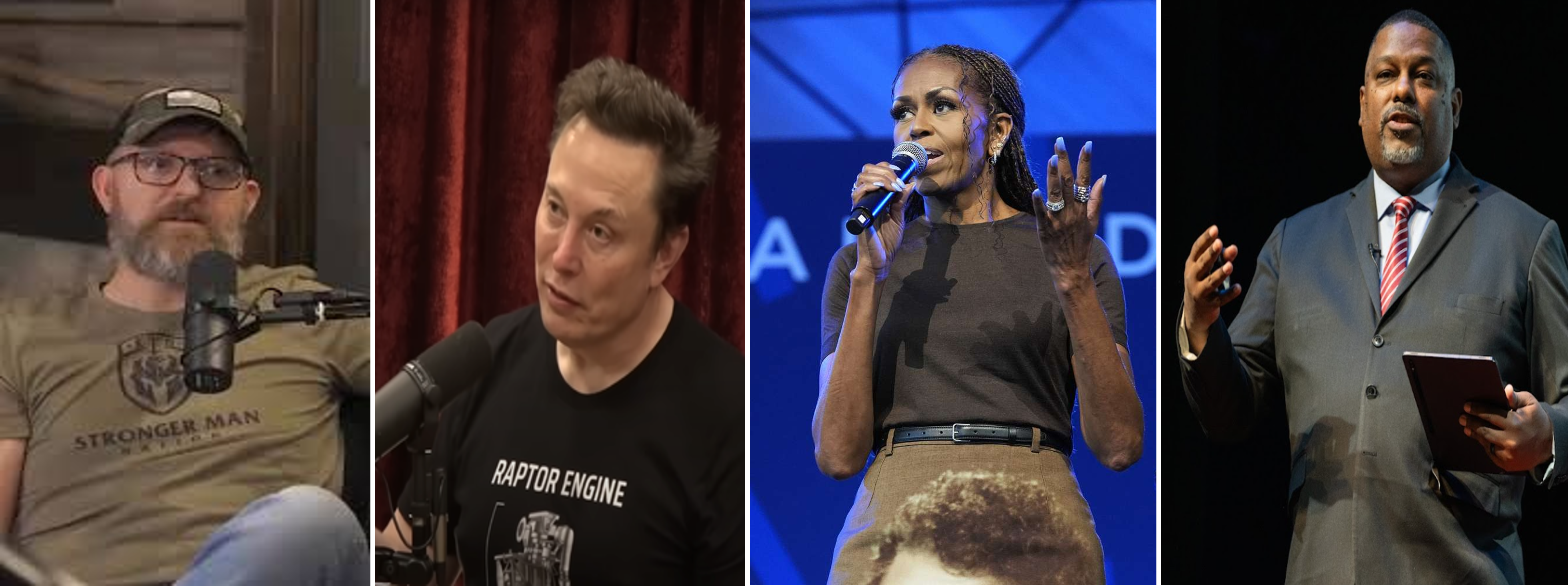
They have named it. They have made it plain.
“Empathy is dangerous. Empathy is toxic. Empathy will align you with hell.” That is Pastor Josh McPherson, on his podcast Stronger Man Nation, speaking with the conviction of a man who believes he is doing God’s work by excising the most generative capacity the human species possesses.
He is not alone.
Trillionaire Elon Musk told Joe Rogan in February 2025 that empathy is “the fundamental weakness of Western civilization,” and that “we’ve got civilizational suicidal empathy going on.” Conservative commentator Allie Beth Stuckey has published a book called Toxic Empathy. Joe Rigney has published The Sin of Empathy. Albert Mohler, president of the Southern Baptist Theological Seminary - one of the most influential evangelical institutions in the world - has declared empathy “destructive” for immigration policy. The late Charlie Kirk said he “can’t stand the word empathy” and called it “a made-up, new age term.”
This is not a fringe position anymore. It is the ideological oxygen of mainstream American conservatism in 2026.
And it is, without equivocation, one of the most dangerous ideas in circulation in the English-speaking world. It is easy to oppose, to write about.
Not because it is loud. Because it is organized. Because it has a purpose. Because its architects understand - even if they won’t say so publicly - that empathy is not a weakness.
It is a superpower.
And if you want to do villainous things to people, to children, to communities, to democracy itself, you first have to kill the capacity in your followers to imagine what those people feel.

Before we dismantle the lie, we need to be precise about the truth.
Empathy is not sentimentality. It is not weakness. It is not naivety. And it is not, as the critics clumsily argue, the same as endorsement.
Empathy is a neurobiological phenomenon: the capacity to perceive, understand, and internally represent the emotional and cognitive states of another person. Social neuroscience has spent the last three decades mapping it with increasing precision. What the research reveals is a system of stunning sophistication, one that is ancient, cross-species, developmentally foundational, and anatomically distinct in the human brain.
There are two primary forms. Affective empathy is bottom-up: your mirror neuron systems and your insula activate when you observe another person’s pain, creating in you a shared representation of that pain. You don’t merely understand what they feel. A part of your nervous system replicates it. Cognitive empathy is top-down: the prefrontal cortex, the temporoparietal junction, and the anterior cingulate cortex work together so you can consciously model another person’s mental state: what they believe, what they intend, what they fear, what they need.
This is what psychologists call Theory of Mind.
Together, these two systems give human beings what no other species has in quite this configuration: the ability to feel and reason our way into another consciousness.
The mirror neuron system, first discovered (by accident!) in macaque monkeys in the 1990s and subsequently identified in humans, fires both when you perform an action and when you observe someone else performing it. This is the biological substrate of imitation, of learning, and of emotional contagion. It is why you flinch when you see someone get hurt. It is why music moves you even when nothing has happened to you personally. It is why the suffering of strangers - if you allow yourself to sit with it - can feel like your own.
The anterior cingulate cortex processes both physical and social pain. When you are excluded from a group, the same neural circuits activate as when you stub your toe. Rejection hurts because evolution built us to care about belonging. And witnessing rejection in others activates those same circuits. This is empathy at the neurological root: we are wired to know that pain is pain, regardless of whose body it lives in.
The insula (that deeply folded cortical region involved in interoception, self-awareness, and emotional processing) is activated both when you experience disgust and when you observe it in someone else. Your body does not fully distinguish between your suffering and the suffering you witness.
This is not a flaw in human design.
This is the feature.
This is the architecture of social cohesion.

It's not just our sense of the empathic substrate of online conversation-spaces like IMO (In My Opinion) with Michelle Obama and her brother, or my wife Laurel’s Get To The Root Of It podcast, that reveal empathy's ongoing worth.
We can go beyond feelings into facts.
The scientific literature on empathy is enormous, deep, and almost uniformly confirming of one central thesis: empathy is among the most consequential and generative capacities the human animal possesses. What follows is not a selective survey. This is what the evidence, across disciplines and decades, actually shows.
On health outcomes: A systematic review published in the Journal of General Internal Medicine, covering 470 empirical analyses from five decades of research in healthcare settings, found that greater clinician empathy is consistently associated with better clinical outcomes and superior patient care experiences. This is not merely patient satisfaction, it is measurable treatment adherence, reduced anxiety, more accurate diagnosis, and faster recovery. Interventions designed to increase clinical empathy showed positive and significant effects in 80 percent of studies. When doctors and nurses are more empathetic, people get better more often and more quickly. The body responds to being seen.
On leadership and organizational performance: Research from the Center for Creative Leadership, analyzing data from 6,731 mid- to upper-level managers across 38 countries, found that managers rated as empathetic by their direct reports were also rated as higher performers by their own supervisors. Not softer. Not kinder, at the expense of effectiveness. Better performers. A systematic bibliometric review of two decades of leadership-empathy research, covering articles from 2004 to 2024 in the Web of Science Core Collection, confirmed that empathetic leadership is linked to stronger employee engagement, higher task performance, better crisis management, and more ethical organizational behavior. When leaders feel what their teams feel, organizations function better.
On child development: Developmental neuroscientists now understand that empathy-related neural circuitry begins developing in the earliest years of life. The temporoparietal junction, the posterior cingulate, and the prefrontal cortex - the brain networks involved in understanding other minds - are already functioning in children as young as three to five years old, as MIT’s Rebecca Saxe has demonstrated using fMRI with young children. The biological and environmental factors that shape empathy interact dynamically from birth. And critically: empathy deficits can be detected in early childhood, meaning that the window for building this capacity is open, and the failure to cultivate it has consequences that compound across a lifetime.
On social cooperation: The evolutionary record is unambiguous. Frans de Waal spent decades documenting empathic behavior in great apes (e.g. consolation, cooperation, grief, and what he called “emotional contagion”) demonstrating that the roots of empathy precede humanity. In humans, empathy is positively correlated with prosocial behavior: helping, volunteering, charitable giving, and cooperative decision-making. Research published through the National Academies of Sciences in 2025 confirmed that empathy undergirds social bonding, parental care, and the prioritization of relationships that holds communities together. It is the load-bearing wall of civil society.
On moral behavior: Neuroscientist Jean Decety has demonstrated through decades of careful research that empathy inhibits unwarranted aggression. When empathic neural circuits are active, the impulse toward harm is suppressed. This finding has been replicated with animal models: inhibiting the anterior cingulate cortex in rats (the region involved in socially triggered fear response) reduces their distress at witnessing another rat in pain, but does not reduce their fear of being shocked themselves. The social circuitry is distinct from the self-preservation circuitry. Take it away, and you remove the brake on harm.
On trainability: Here is what may be the most politically explosive finding in recent empathy research. A 2025 study published in Psychological Science by USC Dornsife psychologists found that empathy is not a fixed trait. It can be trained. Through a mechanism of associative learning - what lead researcher Leor Hackel called “a social twist on Pavlov’s classic experiment” - participants who experienced personal rewards linked to another person’s happiness began to care more about that person, even after the rewards were removed. The effect persisted. The brain learned to value someone else’s wellbeing. Empathy is not destiny. It is cultivated. And it can be uncultivated, too; through competitive framing, through dehumanizing rhetoric, through the deliberate construction of in-groups and out-groups. The anti-empathy right is not simply expressing a view. They are performing a conditioning operation.
On pain and social rejection: Oxford Academic’s Social Cognitive and Affective Neuroscience has published research showing that the neural mechanisms for empathizing with physical pain and social pain are largely shared, and that they grow stronger from adolescence through older adulthood. We become more empathetic as we mature, not less. A culture that suppresses empathy is running against the developmental grain of the human species. It requires active effort. It requires institutions. It requires propaganda.
On psychopathy: The research on psychopathy is particularly instructive. Studies by Christian Keysers and colleagues have found that individuals with psychopathic traits show reduced spontaneous brain activation when observing others in pain…but when instructed to empathize, their brain activity increases to neurotypical levels. The capacity is present. What is absent is the habit. The propensity. The practice. Psychopathy, in this framing, is not the absence of empathy’s hardware. It is the chronic non-use of it. A culture that celebrates non-empathy - one that mocks compassion, that maddeningly codes feeling as weakness - is a culture industrially producing the psychopathic orientation. Not the clinical diagnosis, but the social disposition.
Now we get to the actual argument. Not the scientific one.
The political one.
The anti-empathy project, as it has assembled itself in 2025 and 2026 American public life, is not a coherent theology. It is not a coherent philosophy. It is a consent-manufacturing operation. And its logic, once you see it, is impossible to unsee.
Rev. Canon Dana Colley Corsello, preaching at Washington National Cathedral, named it precisely: the arguments about toxic empathy are finding open ears because far-right evangelicals are looking for a moral framework to justify the Trump administration’s executive orders and policies. That is the function. That is what all of this is for.
Consider the sequencing. Elon Musk calls empathy “civilizational suicide” in the context of immigration. Albert Mohler calls it “destructive” in the context of immigration policy. Within weeks and months: families are separated at the border, ICE operations are launched across American cities, a five-year-old named Liam Conejo Ramos is detained after coming home from preschool in Columbia Heights, Minnesota, despite no deportation order, and is transported to a Texas detention facility where he falls ill with stomach pain, vomiting, and fever. Four U.S. citizen children in Chicago are separated from their parents and detained for hours during a federal immigration raid. In 2025 alone, 32 people died in immigration detention. In the first three weeks of 2026, six more people died in ICE custody.
And the MAGA response to every witness of horror, every community that protests, every school principal who watches a child he knows taken away is: your empathy is being manipulated. Your compassion is a tool of the enemy. Your feeling is the problem.
This is not ideology. This is operating procedure.
Allie Beth Stuckey is transparent about the logic: she worries that if women are allowed to empathize with transgender people, with women who have abortions, with migrants, they will reach the “false” conclusion that these people have valid perspectives — and that conclusion might lead them away from strict Biblical conservatism. She calls this “satanic empathy.” Joe Rigney argues that women’s greater empathic capacity makes them “ill-suited” to applying Christian doctrine because they are inclined to reject teachings they find lacking in compassion (note: not the doctrine of the Greatest Commands to Love, but whatever take on Christ that leaves loving everyone you come across behind and elevates…something else). The solution, in his framework, is male hierarchical authority over feeling itself.
Let us be absolutely clear about what is happening here:
This is not a theological debate about any “proper” weight of emotion in Christian ethics. This is a political project to misdirect at best and dismantle at worst the capacity in ordinary people to be moved by the suffering of those the powerful have decided to harm. It is the pre-authorization of cruelty. And it has named empathy as its primary target because empathy is, in fact, the primary obstacle.
Power without accountability requires an audience that will not feel. Every major atrocity in recorded human history has been preceded, accompanied, and sustained by a systematic effort to reduce empathy: to portray target populations as subhuman, as parasitic, as dangerous…to make it neurologically impossible for ordinary people to map their own emotional experience onto those being destroyed.
This is not hyperbole. This is the damned mechanism.
The Rwandan genocide was preceded by radio broadcasts calling Tutsis “inyenzi,” or cockroaches. Nazi propaganda portrayed Jewish people as rats and vermin. American slavery required the legal and theological construction of Black people as property rather than persons and the depiction of them as ape-like; the explicit suppression of any framework within which enslaved humanity could be recognized as such. Jim Crow, a.k.a. 100 years of American terrorism and lynching, required the daily maintenance of social arrangements that prevented empathic identification across the color line. White people were not supposed to know what Black lives felt like from the inside. Nor vice versa, to be frank. That knowledge was dangerous. That knowledge had to be prevented.
The research on psychopathy shows us that low empathy is the common neurological factor across violent antisocial behavior. People with psychopathic traits are generally less sensitive to their own pain, and consequently underestimate, and discount, the pain of others. A society that is trained, through rhetoric and policy and culture, to underestimate the pain of particular classes of people is performing psychopathic behavior at the collective level. It is not individual pathology. It is political design.
And it generates a psychopathic nation!
The researchers who study competitive versus cooperative social environments have found something important: empathy grows in cooperative settings, where one person’s success benefits everyone. In competitive zero-sum settings, where someone else’s gain is your loss, the emotional bonds that produce empathy are harder to form. The entire ideological architecture of white nationalist and far-right politics is built on zero-sum framing: there is not enough to go around, your share is being taken, their gain is your loss.
This is not a description of reality.
It is an empathy-suppression technology. It makes it psychologically costly to feel what others feel, because their well-being has been coded as your threat.
And that is why they are afraid of empathy. Not because it is weak. Because it is stronger than their arguments. Because a person who genuinely feels what a detained five-year-old child feels cannot simultaneously believe that the detention was necessary. Because a person who genuinely inhabits the experience of a woman forced to carry a pregnancy against her will cannot simultaneously believe she has no claim to her own body. Because empathy is the direct adversary of the political project that requires you to believe that some people’s pain just doesn’t count.
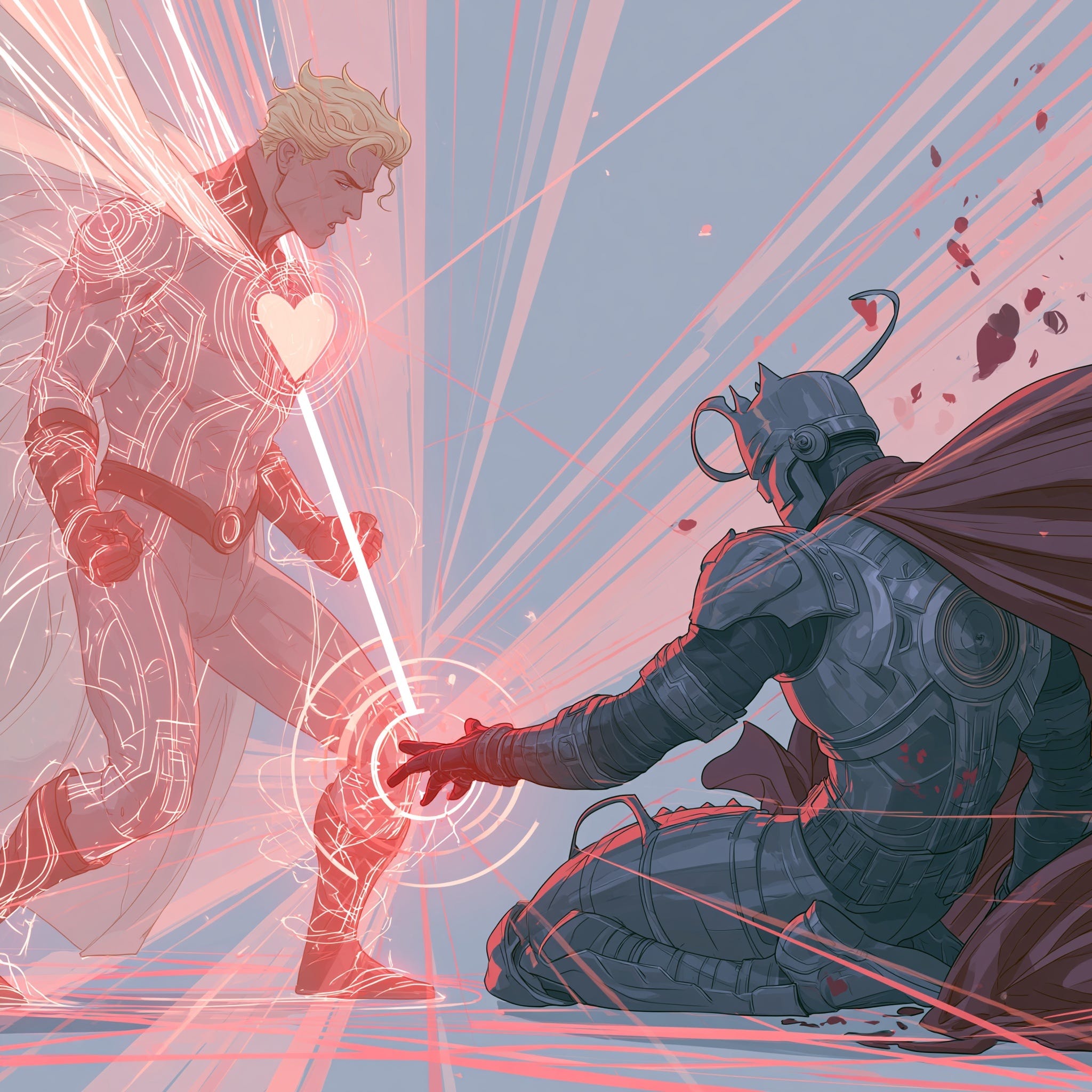
Empathy counts the pain. That is its function. That is what makes it superheroic. And that is what makes it dangerous…but only to super-villains.
The USC research on empathy training tells us something that, to me, is urgent:
Empathy grows in cooperative environments.
It grows when someone else’s happiness is connected to our own reward. It grows when we are structurally positioned to benefit from the wellbeing of others. And it can be systematically suppressed by competitive framing, by dehumanizing rhetoric, by the relentless cultural coding of certain people as threats rather than neighbors.
This means the stakes of the anti-empathy cultural project are not merely rhetorical. They are neurological. They are national. They are planetary.
Every child raised in an environment that mocks compassion, that frames feeling as feminine weakness, that codes the suffering of out-groups as deserved or irrelevant — that child’s empathic neural circuitry is being conditioned away from its natural developmental trajectory. We are talking about a generation-scale project of emotional crippling, dressed in the language of strength.
But the developmental research also tells us something hopeful. Empathy is not fixed. It is plastic. It can be trained, cultivated, grown. Mindfulness-based programs, compassion-focused interventions, educational curricula that center perspective-taking…these work!
The effect sizes are modest in laboratory settings, but the mechanisms are real. And crucially, as Oxford’s Social Cognitive and Affective Neuroscience research shows, humans become more empathetic as they age. The developmental arc of the species bends toward feeling. The anti-empathy project is fighting biology.
It may win battles. Cultural conditioning is powerful. But the research suggests that at some level, suppressing empathy requires constant renewal. It requires perpetual propaganda. It requires institutions, and podcasts, and books, and sermons, and algorithms, and a political party, and a billion-dollar influencer ecosystem…because the moment the pressure lets up, people start feeling again. They start seeing the children. They start seeing the bodies. They start seeing the five-year-olds.
This is why the anti-empathy movement is not simply wrong. It is desperate.
It is the sound of people who know they cannot survive in a world where most people are allowed to feel what other people feel. It is the sound of the villain who cannot bear the hero’s power.
Empathy is that power.
Empathy is the ability of the human animal to know that another being suffers, and to let that knowing matter. It is the neural ground of solidarity. It is the prerequisite of justice. It is the biological argument against every system that depends on some people not counting. It is 65 million years of social mammal evolution building toward the moment when a creature could look across every boundary of tribe, nation, race, gender, and circumstance and say: I know what you feel. And it matters.
They are afraid of that moment.
They should be.
If this essay moved you…share it. Forward it. Post it. The anti-empathy project has billions of dollars and a streaming platform. We have the truth, and each other. Subscribe to Ṣẹ́gun Irora at segunirora.substack.com.